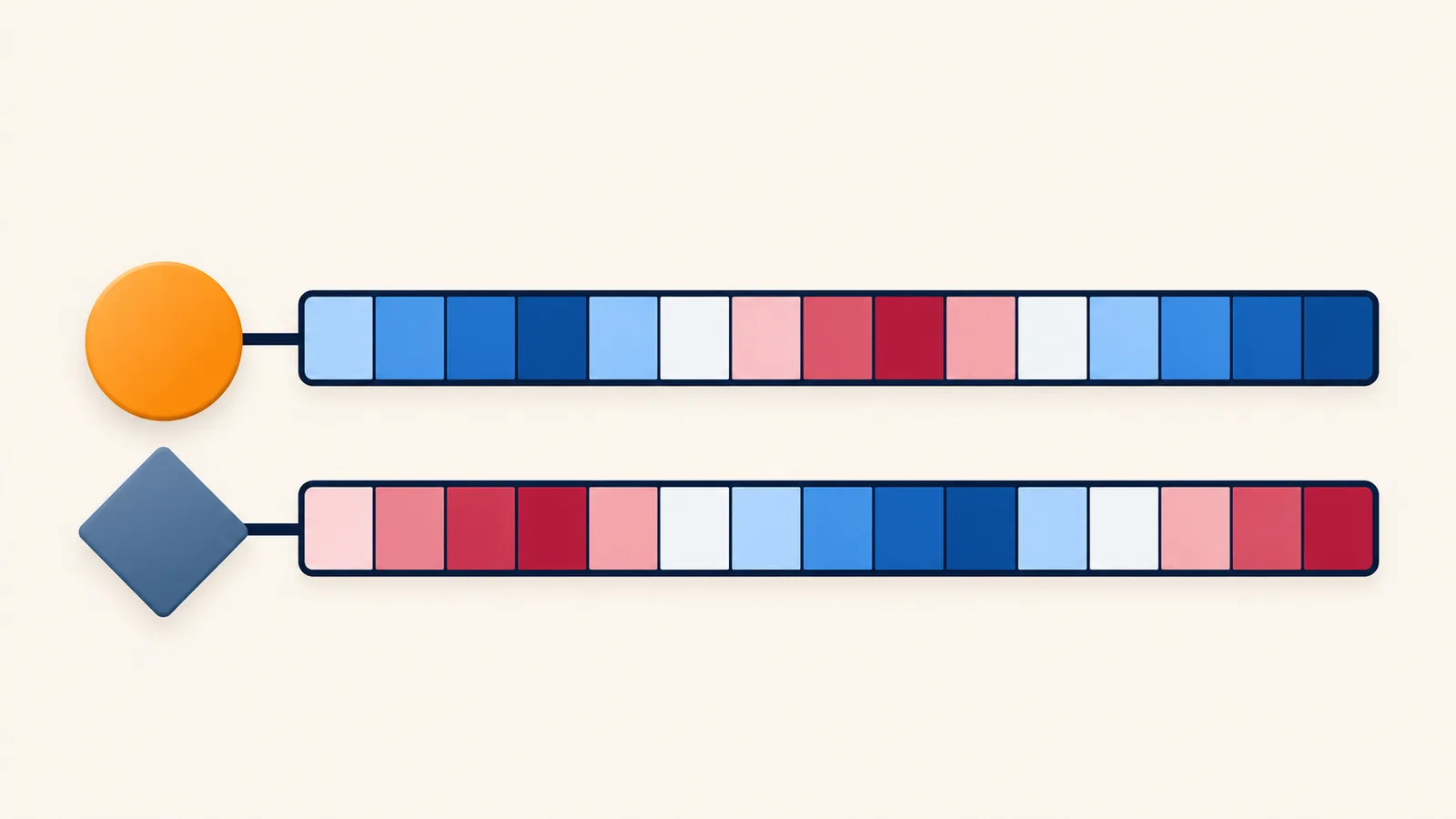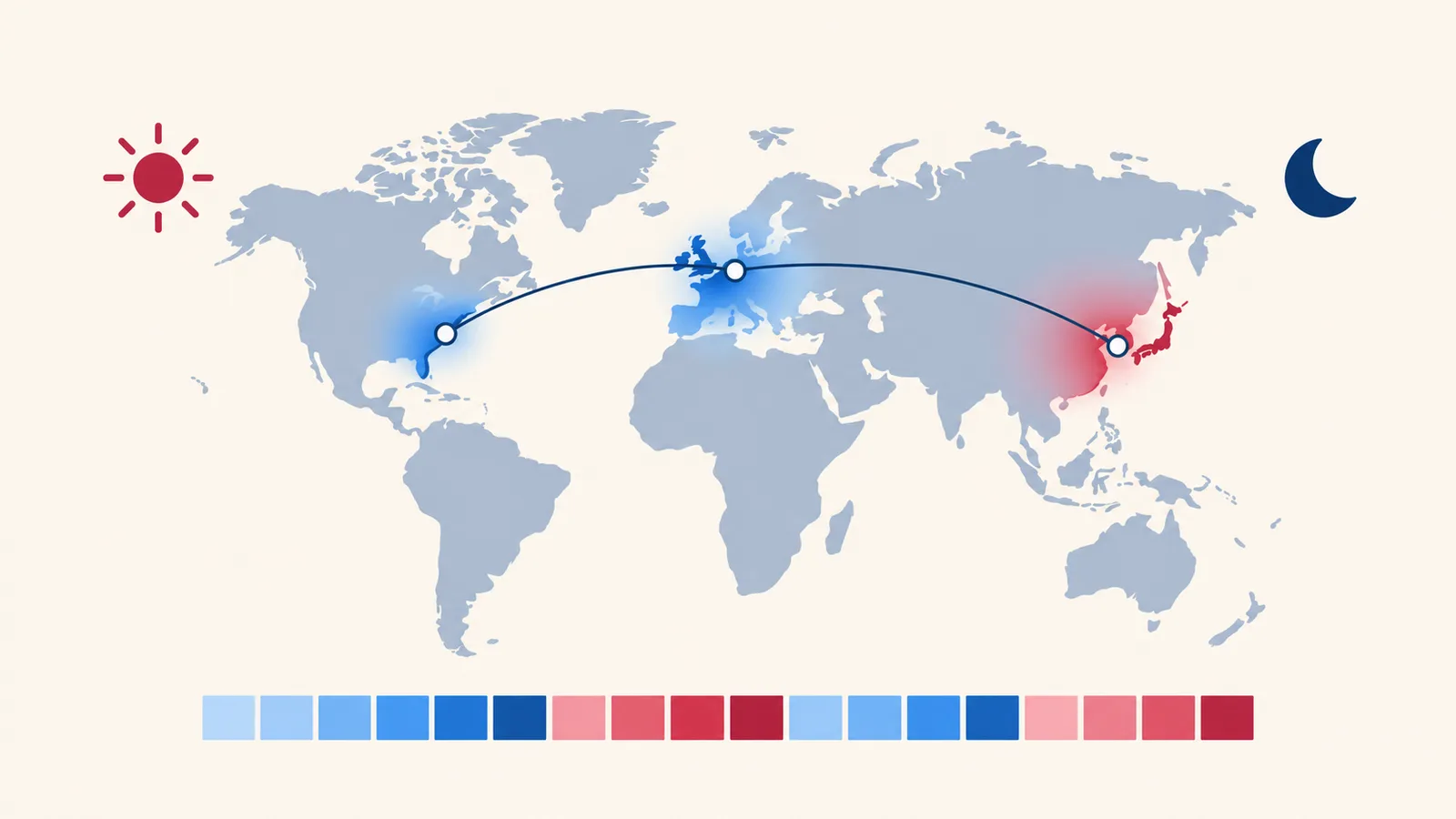
Summary. Crypto trades all day, but traders still talk about Asia, London, and New York sessions. This guide places those sessions on a New York clock, shows where they overlap, and reads 90 days of Bitcoin hourly bars against them. The session hours are a working convention, not an exchange rule.
Stock exchanges open and close. Crypto markets do not. Even so, the habit of speaking about "the Asia session" or "the London open" survives, because the people and firms who trade follow business hours in their own cities. For a US reader the useful question is where those windows fall on a New York clock, and whether the stored hourly bars look different inside them.
The three sessions on one clock
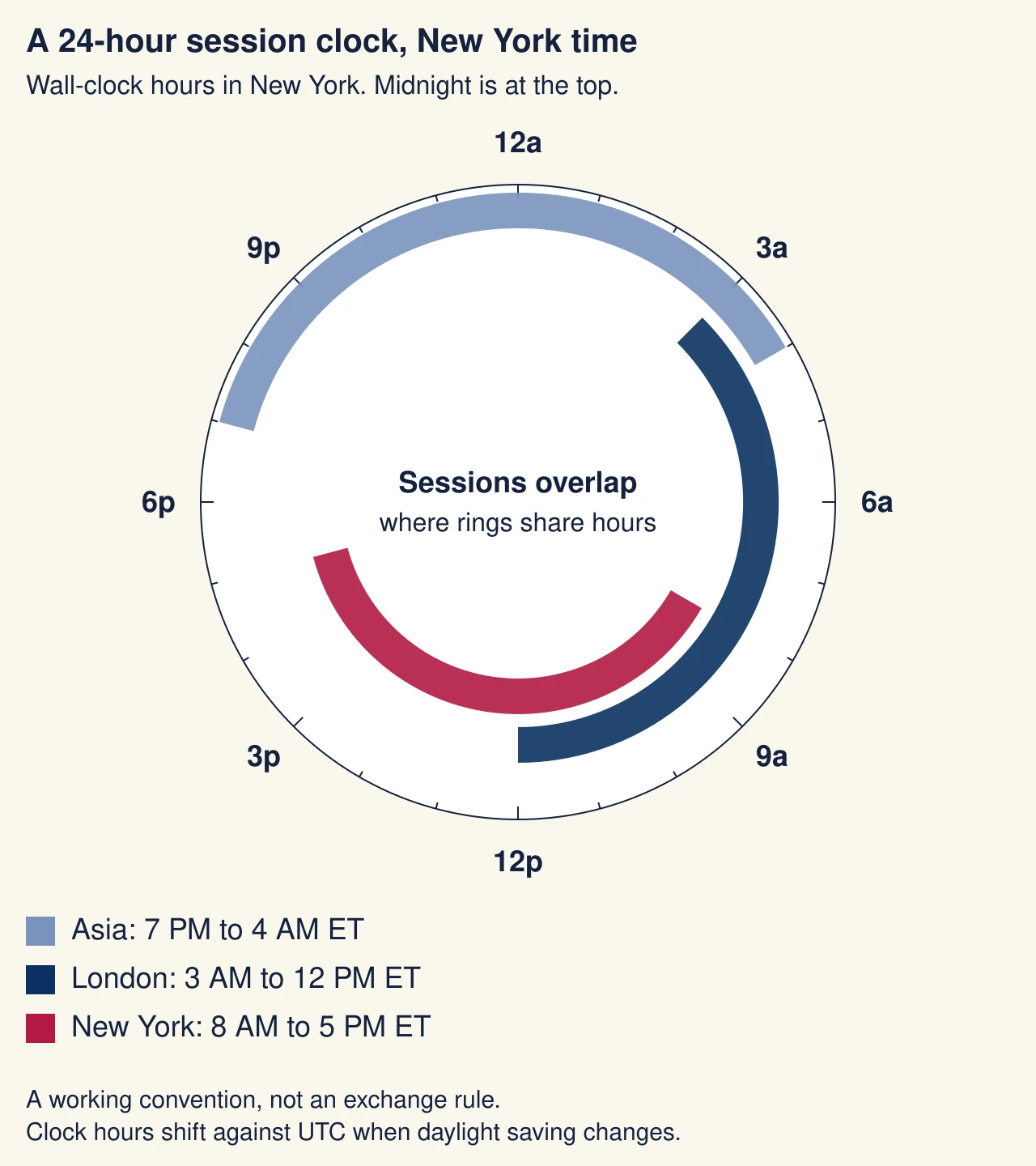
The clock above uses wall-clock New York hours with midnight at the top. Asia, London, New York are drawn as three rings so the overlaps are visible: the hours where two rings cover the same part of the dial.
Two of the anchors are fixed and published. The New York Stock Exchange core session runs from 9:30 AM to 4:00 PM Eastern, as set out on the NYSE hours and calendars page. The Tokyo exchange runs a morning session from 9:00 AM to 11:30 AM and an afternoon session from 12:30 PM to 3:30 PM Japan time, per the Japan Exchange Group trading hours. Tokyo has no daylight saving, so in winter, when New York is on standard time, that morning open falls at 7:00 PM the previous evening Eastern, and at 8:00 PM once New York is on daylight time. The London window in our clock is the usual business-day convention rather than a published trading schedule.
That one-hour drift is the reason the sessions do not stay put against New York time. London and New York change clocks on different dates, so the gap between them narrows or widens for a few weeks each spring and fall. The IANA time zone database holds the rules.
How we measured it
The data is Bitcoin hourly bars from Binance spot (BTCUSDT), grouped by New York clock hour for the 90 days from Aug 25, 2026 through Nov 22, 2026, queried on Nov 23, 2026, 08:00 ET. Of the 24 New York clock hours, 24 had at least one completed BTC bar, for 2,153 bars in total. At the query time the newest stored candle was inside the 90-minute freshness window.
For each session we took the New York clock hours it covers on the clock above and averaged the hourly standard deviations of Bitcoin returns across them. An hour that sits in two sessions, such as the overlap between London and New York, counts in both. The result is a description of how widely returns scattered inside each window. It is not a ranking of which session is better.
What Bitcoin did in each window
Averaging the hourly spreads inside each window, the London session had the widest mean spread (0.46 points) and the Asia session the narrowest (0.41 points).
| Session | Clock hours with bars | Bars | Mean spread (points) | Up share of moving bars |
|---|---|---|---|---|
| Asia | 9 | 808 | 0.41 | 48.8% |
| London | 9 | 804 | 0.46 | 46.6% |
| New York | 9 | 809 | 0.45 | 49.0% |
Check the hour counts before the spreads. A session that covers fewer clock hours with bars gives a less stable mean, and the overlap hours count twice. The up share column counts bars that closed higher as a share of bars that moved either way. It is close to even when up and down days balance, and a share near a half tells you nothing about the next hour.
Swipe sideways for all 24 hours.
| Hour | 12a | 1a | 2a | 3a | 4a | 5a | 6a | 7a | 8a | 9a | 10a | 11a | 12p | 1p | 2p | 3p | 4p | 5p | 6p | 7p | 8p | 9p | 10p | 11p |
|---|---|---|---|---|---|---|---|---|---|---|---|---|---|---|---|---|---|---|---|---|---|---|---|---|
| BTC | +0.01% | +0.08% | −0.01% | +0.01% | +0.07% | −0.01% | +0.01% | −0.01% | −0.05% | −0.03% | −0.05% | −0.05% | −0.00% | −0.01% | −0.03% | +0.01% | −0.07% | −0.02% | +0.03% | −0.02% | −0.07% | −0.07% | −0.03% | −0.00% |
The row above is the live 90-day grid in New York time. Compare it with the clock: find the columns for each ring and see whether the colors change near the edges. The caption lists the dates it covers.
How to use a session map
Use it to name the hour you are looking at. If a number on the Bitcoin page sits in the 9 AM column, you now know that is the hour New York stocks open at 9:30, and the hour London is in the middle of its day. Use the hours section to compare every tracked coin in a single hour, and read crypto market hours for the broader picture.
Do not use it as a trigger. A session is a label for people's schedules. It does not cause a move, and the label drifts against the clock twice a year. For a close look at which hours showed the widest Bitcoin swings, see what time of day Bitcoin moves the most. Paid plans add longer windows and the API; the pricing page lists them.
FAQ
Do crypto markets close between sessions?
No. Bitcoin and other coins trade continuously. A session is a convention about who is awake and active, not a market that opens and shuts.
Which session is the most active?
In the table above, the one with the widest mean spread in this 90-day window. Another window can rank them differently, and the hours counted in two sessions pull the means together.
Why does the clock shift in spring and fall?
New York, London, and Tokyo do not all observe daylight saving, and they change on different dates. The same UTC hour therefore carries a different New York label for part of the year.
Can I see the sessions in UTC or London time?
Yes. Switch the zone control on any grid. The bars are the same, and only the hour label changes.
Historical statistics, not predictions or financial advice.